What can "supports Bahasa Indonesia" mean?
Four different things often hide behind the same line. Ask about each one.
| Type of support | What it means | Question for the vendor |
|---|
| App screens | Menus and buttons in Indonesian | Are all screens translated, including the ones cleaners use? |
| Training | Staff are taught how to use the system | Who trains, in which language, and what about new staff? |
| Help articles | Written guides and videos | Are the guides in Indonesian, or only in English? |
| Human support | A person who answers when there is a problem | Is it a person fluent in Indonesian, or machine translation? |
All four matter. But human support is the one you feel most when something breaks. Nice screens do not help if the OTA price is wrong at 9 pm and nobody can talk to you.
Watch out for two things that look similar. First, an Indonesian phone number on the website. A local number does not always mean an Indonesian speaker answers. Second, a chatbot that replies in Indonesian. A chatbot can help with simple questions, but it is not a person when a booking goes wrong.
For the bigger picture on choosing a system, start with our guide on how to choose a PMS for a small hotel in Indonesia (opens in new tab). This article focuses on one part only: support.
What hours is support open, and in which time zone?
Indonesia has three time zones. Keppres No. 41 Tahun 1987 (opens in new tab) sets them as WIB (GMT+7), WITA (GMT+8) and WIT (GMT+9). So "open from 08:00" can mean a different hour for a hotel in Yogyakarta, Bali or Jayapura.
When a vendor gives its hours, ask them to write the time zone. Then work out what those hours are where your property is.
Also ask:
- Which days? Are weekends and public holidays covered? Hotels are often busiest on those days.
- What is covered after hours? Many vendors offer 24-hour help, but only for system failures. Normal questions wait until morning.
- Who answers after hours? Is it still in Indonesian, or does it switch to English?
A time zone example (made up)
A made-up guesthouse in Yogyakarta (WIB) uses a vendor from overseas. The vendor lists support hours of 09:00 to 17:00 GMT+1. That sounds normal. But in Yogyakarta, it means 15:00 to 23:00 WIB. In the morning, when guests check out and new bookings arrive, nobody answers.
The owner only finds out when the first problem happens at 10:00. They wait five hours for a reply. One simple question before signing would have saved that.
The same can happen inside Indonesia. A vendor working on WIB hours closes one hour earlier by the clock of a property in Bali or Lombok, and two hours earlier for a property in Papua. That small gap matters when the last guest checks in late and there is a problem with the booking.
How do you test support with one problem?
The best way to judge support is to give the vendor one real-looking problem and see how they answer. Do it during the demo or before you sign.
A test problem (made up): "The Deluxe room price for the 20th is different on one OTA from the price in the PMS. What do you do, and what do you need from me?"
A good vendor will ask for clear details, such as:
- Your property ID or name in the system.
- The channel or OTA name.
- The date and room type with the problem.
- The price it should be, and the price that shows.
- A screenshot, with guest details hidden.
Never send your extranet password or guest card details in chat. A good vendor will not ask for them. Indonesia's data protection law, UU No. 27 Tahun 2022 (opens in new tab), is a good reason to share as little guest data as possible.
Do not test in a way that could break real bookings, like closing all rooms on a busy date. Just ask for the steps.
A first reply is not the same as a fix
When a vendor gives you a time, ask what that time is for. There are four different stages:
| Stage | What it means | What to ask |
|---|
| First reply | Someone answers your message | Is this a target or a written promise? |
| Workaround | A way to keep selling for now | What can staff do while they wait? |
| Fixed | The cause is solved | Who tells you when it is done? |
| Escalation | The issue goes to a tech team or the OTA | Who owns it after it is passed on? |
A reply in 15 minutes is not a fix in 15 minutes. An honest vendor will keep the two apart. If a time is called a target, ask whether the contract also promises it in writing.
Who handles OTA problems, and who handles the PMS?
Not every problem can be fixed by the PMS vendor. Some sit with the OTA. Ask how the work is split.
- The PMS connection to an OTA breaks. The PMS vendor usually checks it first, then contacts the OTA if needed. Ask if you will be told, and how.
- Prices or availability do not match. The cause can be a setting in the PMS or in the OTA extranet. Our guide on room price differences across OTAs (opens in new tab) helps you find it.
- Guest messages and reviews. For some OTAs, messages and reviews stay in that OTA's own extranet. On Traveloka, for example, you reply in TERA. Our Traveloka TERA guide (opens in new tab) explains how.
- OTA payments and commission. This is between you and the OTA. A PMS vendor usually cannot change it.
If you are about to connect Traveloka, tiket.com or Agoda, also read how to connect Traveloka, tiket.com and Agoda to a channel manager (opens in new tab). Ask the vendor which parts they help with and which parts you handle yourself in the extranet.
What should staff do while they wait for an answer?
Even with good support, there may be a short wait. Teach your team a few calm steps, so a small problem does not grow.
- Write down what happened. The time, the room, the channel and what looked wrong. One line in a shared note is enough.
- Take a screenshot. Hide guest names and phone numbers before you send it.
- Change one thing at a time. If staff change prices in three places at once, it is hard to find the cause later.
- Enter outside bookings right away. A booking taken by WhatsApp, phone or walk-in must go into the system at once. If it waits, the same room can be sold again on another channel.
- Tell the guest only what you know. For example, "We are checking your booking and will reply within the hour." Do not guess.
These steps help support find the cause faster. They also protect your guests while you wait. If a guest was booked twice, our guide on what to do when a guest is double-booked (opens in new tab) walks you through it.
Keep a simple support log
For the first month after go-live, keep a short log of every question you send to support. Note the date, the problem, who answered and when it was fixed. After 30 days, read it with the vendor. You will see which problems keep coming back, and which staff need more training. It also shows you how support really works, not just how it was described in the demo.
Who sets up the system and trains staff?
Many support problems start after the person who set up the system leaves. Staff change, and new staff do not know how to use it.
Ask:
- Who does the setup? Does the vendor help enter rooms, rates and channels, or do you do it alone?
- How is training done? At the property, by video call, or only through articles?
- What about new staff? Is there training again when a receptionist or cleaner changes?
- Who is your regular contact? Is there a group or channel just for your property, or does every question go into one shared queue?
Also make sure your staff can use the system in a language they understand. A cleaner reading room status in English is more likely to make mistakes than one reading it in Indonesian. To see what a PMS does day to day, read what a hotel PMS is (opens in new tab).
How do you keep the vendor's answers before you sign?
Spoken promises in a demo are easy to forget. Ask for the key answers in writing, by email or message, and keep them.
Things to get in writing:
- Support hours, with the time zone.
- What is covered after hours.
- The language the support team uses.
- Any times they mention, and whether each is a target or a contract promise.
- Who does the setup and training.
- How to reach support, for example WhatsApp, email or phone.
Keep these answers in one place the owner and manager can both open. If support ever falls short, you have a clear record to talk about.
Common mistakes to avoid
- Thinking an Indonesian website means an Indonesian team.
- Not asking about the time zone. 08:00 in one country can be midnight where you are.
- Thinking "24 hours" covers every question. Often it is only for system failures.
- Mixing up a first reply and a fix.
- Sending passwords or guest card details in chat.
How does Kiyo support you in Bahasa Indonesia?
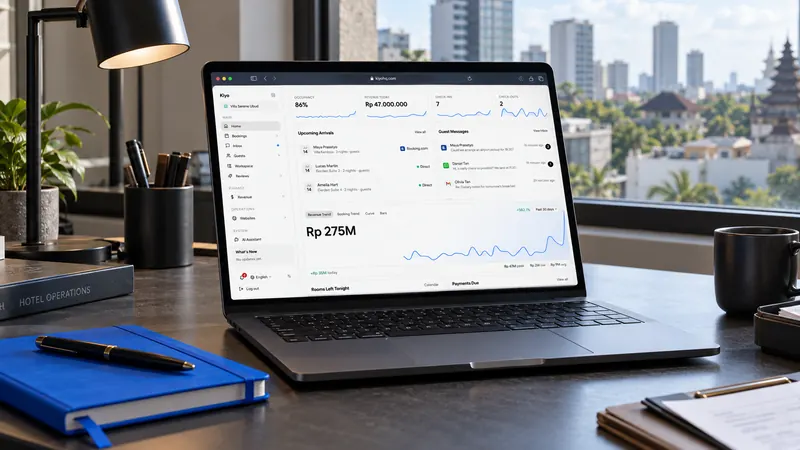
Kiyo is a PMS and channel manager for independent hotels, villas and guesthouses. Kiyo has an Indonesian team and offers support in Bahasa Indonesia.
A WhatsApp group for each property. Each property gets its own WhatsApp group with the Kiyo team. Normal support runs from 07:00 to 19:00 WITA. That is 06:00 to 18:00 WIB, or 08:00 to 20:00 WIT. For system failures, support is there 24 hours a day.
A reply target, not a contract promise. In support hours, we aim to reply within 15 minutes, and at most 2 hours. This is a target for the first reply, not a deadline for the fix.
Alerts when an OTA connection fails. If a connection to an OTA fails, your property is told and the Kiyo team gets an instant alert too. So we can start checking, sometimes before you message us.
The app in Bahasa Indonesia. All staff screens are available in Bahasa Indonesia, including the cleaner app in the phone browser. Kiyo connects to 75+ OTAs, including Traveloka and tiket.com. When a room is booked, it locks on all channels within milliseconds.
Setup with you. The Kiyo team sets up your rooms, rates and channels with you. In Bali, we can visit your property to show you. Outside Bali, we do it by video call. If you want to know whether Kiyo fits your property, read is Kiyo right for your property (opens in new tab).
Plans start from Rp40k per room per month (opens in new tab). Free setup, pay from go-live, 14-day money-back guarantee.
Frequently asked questions
Not always. Many vendors offer 24-hour help only for system failures, and the language can change after hours. Ask about both in writing.
No. A first reply means someone has answered. A fix can take longer, especially if the OTA needs to help.
Traveloka messages and reviews are handled in the TERA extranet. A PMS vendor can help with the connection, prices and availability, but ask about the limits clearly.
Your property name or ID, the channel, the date, the room type, what should happen and what does happen, plus a screenshot with guest details hidden.
A WhatsApp group makes talking easier, but it is not a promise of reply time. Ask for the vendor's hours and reply target, and whether they are in the contract.
 Add Kiyo to your preferred sources on Google