Six fit questions to ask about any hotel system
Write your answers down before any demo.
- What kind of property do you run? A 20-room hotel, a private villa and a 4-room homestay need different things. A hotel needs room types and a front desk view. A villa may be one unit that sells as a whole.
- How many rooms or villas do you run? Kiyo prices per room or villa unit, plus a monthly base fee. All your villas can sit in one account, even in different areas.
- Which booking sites bring your guests? An online travel agency, or OTA, is a site like Booking.com, Agoda or Traveloka that sells your rooms for a commission. A channel manager is the tool that sends your prices and free rooms to each OTA and pulls the bookings back. List the OTAs that bring most of your guests.
- Who runs the desk each day? Maybe it is you. Maybe it is a manager, two front desk staff and three cleaners. Think about their language and their device.
- What can you spend per room each month? Compare the monthly cost to one night of one room. If a room sells for Rp500,000 a night, a system that costs a small part of one night per room each month is easy to judge.
- What help do you need to start? Ask who enters your rooms and rates, and which language support speaks.
Here is how that looks for three made-up owners. Ibu Komang runs a 4-room guesthouse in Ubud. Most guests come from Booking.com and Airbnb, and she does the desk herself. Pak Hendra runs a 15-room hotel in Yogyakarta. He sells on Traveloka and tiket.com and has a team of six. Mr Daniel owns two villas in Lombok but lives in Jakarta, so his villa manager does everything on a phone.
The 60-second fit table
Answer yes or no to each row, then read the plan in the last column. The plan in your lowest "yes" row is the one that fits.
| Question | If yes | Plan that fits |
|---|
| Do you want the core tools, for one villa or many? | One calendar, 75+ OTAs and your own booking page cover it | Starter |
| Do more than 3 people need a login, including you? | Starter includes 3 team members; Pro and Business have unlimited seats | Pro |
| Do guests message you every day on WhatsApp, Instagram and OTA chats? | One shared inbox saves the most time | Pro |
| Do you want Booking.com, Airbnb and Expedia reviews in one place? | The reviews dashboard is on Pro | Pro |
| Do you run a bigger operation, with more units, more staff and more needs? | Advanced controls, multi-property reports and priority support | Business |
| Do you want cleaning jobs sent to your cleaners? | Housekeeping is on Business | Business |
| Do you run an agency, a villa group or 50+ rooms? | A plan built around your property list | Talk to us |
Worked example: Ibu Komang says yes to the first row only, so Starter fits. Pak Hendra has a team of six and busy guest chats, so Pro fits. Mr Daniel has two villas and wants cleaning jobs sent to his cleaners, so Business fits. The number of villas did not decide it. His needs did.
What Kiyo gives every property
Kiyo is a PMS and channel manager for independent hotels, villas, guesthouses, homestays and hostels. The founder story is on the Why Kiyo page (opens in new tab).
Every property, of every type and size, starts with the same base:
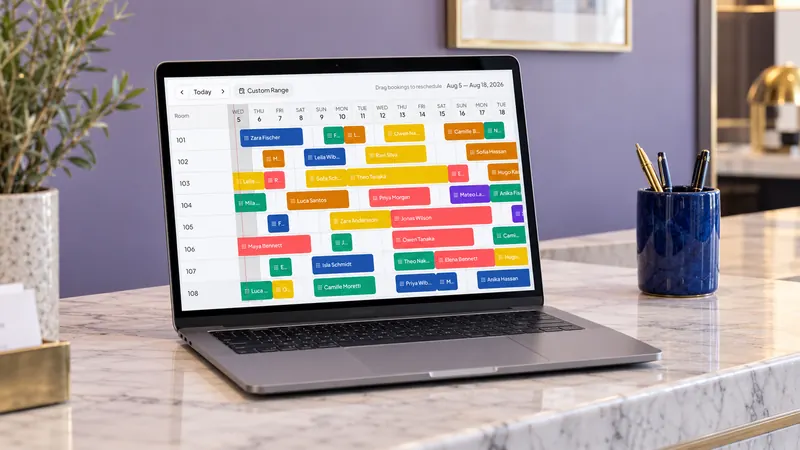
- One calendar for every booking. Direct bookings, OTA bookings and bookings your team types in all sit on one calendar.
- 75+ OTAs. Kiyo connects to 75+ OTAs, such as Booking.com, Agoda, Expedia, Airbnb, Traveloka, tiket.com and Trip.com. The channel manager page (opens in new tab) shows how the connection works.
- One sale closes the room elsewhere. When a guest books a room on one connected channel, Kiyo closes that room on your other connected channels.
- Your own booking page. A direct booking engine comes with every plan, so guests can book on your website.
- Bahasa screens and a login for each person. Staff can switch the whole dashboard to Bahasa Indonesia. Starter includes 3 team members, including the owner; Pro and Business have unlimited seats.
One tip: most double bookings come from a WhatsApp, phone or walk-in booking that nobody enters right away. Our guide on how to stop double bookings (opens in new tab) explains the habits that close that gap.
How each property type gets value
Hotels. A hotel has room types, a front desk and often a bigger team. Reception can add a walk-in guest as a booking marked "Walk-in", or mark a booking as already paid. Each booking keeps its payments and refunds and can make a receipt. Each booking also has a history, so you can see who changed what, and when.
Villas. A villa often sells as one whole unit, sometimes on several sites at once. Kiyo puts Airbnb, Booking.com and your own booking page on one calendar. When the villa sells on one connected channel, it closes on the others. Owners far away can check bookings in a phone browser. Our post on the best PMS for Bali villas (opens in new tab) covers villa needs in more depth.
Guesthouses and homestays. All bookings land on one calendar, the booking page is included, and the screens work in Bahasa. On the Pro plan, a shared inbox brings guest chats from WhatsApp, Instagram, Facebook, Telegram, Outlook, Booking.com, Airbnb and Expedia into one place.
Hostels. The same channel manager and calendar keep every short-stay booking in one view. Beds and dorm rooms work differently from private rooms, so ask us in the demo how your beds, dorms and prices are set up.
Here is what our three owners get today.
| Owner | What they need | What Kiyo gives them |
|---|
| Ibu Komang, 4-room guesthouse, Ubud | Booking.com and Airbnb on one calendar, little admin | Both connect, bookings land on one calendar, direct booking page included |
| Pak Hendra, 15-room hotel, Yogyakarta | Traveloka and tiket.com, a team of six, Bahasa | Both are named connections, each person gets a login, screens switch to Bahasa |
| Mr Daniel, 2 villas, Lombok | Run two places from Jakarta, manager on a phone | Both villas sit in one account, Business sends cleaning jobs, and the dashboard works in a phone browser |
How each size gets value
Your needs choose the plan, not how many villas you count. Say you have Villa A, B and C in Sanur and Villa D in Seminyak. Is that one property or four? For your plan, it does not matter. All four can sit under one Starter, Pro or Business account. You pay per room or villa unit, plus the plan's base fee.
Running an agency, a villa group or 50+ rooms? The pricing page (opens in new tab) says: "Let's build a plan that fits." Bring your property list to the demo.
What each plan includes
Kiyo has three plans. Every plan includes the channel manager, the calendar, the direct booking engine and the revenue dashboard. The pricing page (opens in new tab) also lists "Payment links & guest emails" as included on every plan.
On price, plans start from Rp40k per room per month (opens in new tab). A 10-room hotel on Starter pays about Rp550k a month, and that includes the channel manager. Yearly billing costs less than paying month by month.
Setup and support in Bahasa
- A short first chat. You tell the Kiyo team about your rooms, your OTAs and your team, on WhatsApp or a call.
- Rooms and rates go in. The Kiyo team sets up your room types, rates and booking page with you.
- OTAs get connected. The team connects your OTAs with you. For Traveloka, you will need access to TERA, the Traveloka partner extranet (opens in new tab). For tiket.com, you will need TIX, the tiket.com partner extranet (opens in new tab). Our posts on logging in to Traveloka TERA (opens in new tab) and tiket.com for small properties (opens in new tab) explain both.
- Your team logs in. Each person gets their own login and a preset role, in English or Bahasa.
- Go-live. Your calendar goes live and you watch the first bookings come in.
After go-live, each property gets its own WhatsApp group with the Kiyo team. Support hours are 07:00 to 19:00 WITA, plus 24/7 help when the system fails. Inside those hours, we aim to reply within 15 minutes, and within 2 hours at most. That is a target we set for ourselves. The Kiyo team is Indonesian and gives support in Bahasa Indonesia.
Security is part of setup too. Every user can switch on two-factor login, or 2FA. That means a 6-digit code from an app like Google Authenticator (opens in new tab) on top of the password. Billing and payout screens stay off for staff until the owner turns them on for a person with 2FA. Our guide on hotel staff system access (opens in new tab) covers how to plan who sees what.
Your first 14 days after go-live
Changing systems feels risky. So run your normal week inside Kiyo and try these tests:
- The last-room test. Take one booking on an OTA for your last free room. Then check that the room shows as closed on your other connected OTAs.
- The walk-in test. Ask your front desk to add a walk-in guest, mark it paid, and find it again on the calendar.
- The Bahasa test. Let your least techy staff member switch to Bahasa and do one task alone, on their own phone.
- The support test. Ask one real question in your WhatsApp group during the day and see how the answer feels.
A first booking day: Ibu Komang in Ubud
Here is one day in the first two weeks for Ibu Komang, our made-up owner in Ubud.
- Morning. Her Booking.com and Airbnb listings are connected, and her calendar shows the week ahead in one view.
- Late morning: an OTA booking. A couple from Sydney books two nights on Booking.com. The booking lands on her calendar, and Kiyo closes that room on Airbnb and on her booking page, so nobody else can take it.
- Afternoon: a walk-in. A backpacker walks in and asks for one night. Ibu Komang adds the booking as a walk-in and marks it paid, so it sits on the same calendar.
- Evening: a direct booking. A returning guest asks on WhatsApp for three nights in December. She adds the booking and sends a payment link, and the guest gets a booking confirmation email.
- Night: a question. She wants to set a holiday rate, so she asks in her Kiyo WhatsApp group and gets the steps in Bahasa.
By the end of the day, no booking was typed twice.
Your next step: book a demo and run the last-room test on your own rooms.
Plans start from Rp40k per room per month (opens in new tab). Free setup, pay from go-live, 14-day money-back guarantee.
Frequently asked questions
Kiyo is a PMS and channel manager for independent hotels, villas, guesthouses and hostels in Indonesia, connected to 75+ OTAs. Your calendar, front desk, direct booking page and revenue dashboard sit in one place. It is one full system, not just a PMS, and the team is working toward more tools such as accounting. Use the 60-second fit table above to see which plan suits you.
Yes. A single villa runs on one calendar with its own booking page, and when it sells on one connected channel, Kiyo closes those dates on the others. Guesthouses, homestays and hostels use the same base.
Kiyo connects to 75+ OTAs, such as Booking.com, Agoda, Expedia, Airbnb, Traveloka, tiket.com and Trip.com. Ask us in the demo to check any smaller OTA you use.
One account holds all four villas, even in two areas. Plans are not counted by how many villas or properties you have. You pick the plan by your size and needs: Starter for the core tools, Pro for a busy inbox, Business for housekeeping and a bigger team. You pay per villa unit. For an agency or 50+ rooms, the Kiyo team can build a plan that fits.
No long contract. Plans are monthly or yearly. The Kiyo team sets up your rooms and rates with you and reconnects your OTAs, so you do not rebuild anything alone. Timing depends mostly on how fast each OTA approves the connection.
 Add Kiyo to your preferred sources on Google