What makes a guest house or homestay different from a hotel?
A hotel has a front desk, a reservations team and a manager for each department. A homestay often has one family. The same person may cook breakfast, answer WhatsApp, clean two rooms and greet a new guest before lunch.
That changes what software needs to do. Small places are very common in Indonesia. The national statistics agency, BPS, counts non-star hotels and other lodgings (opens in new tab) in their own table, apart from star hotels. Many of these places have only a handful of rooms. In Bali they are a big part of why visitors love the island: you stay in a family compound in Ubud or Sidemen, eat breakfast made by the owner, and get tips no hotel desk would give.
Here is what is usually true for a small guest house or homestay:
- The owner lives on site or close by. Decisions happen fast, often on the phone.
- Many bookings come direct. Repeat guests, friends of past guests and WhatsApp chats matter a lot.
- Breakfast and small extras are part of the stay. They are often included in the room price.
- Staff wear many hats. One person may handle cleaning and check-in.
- Money is tight in low season. Every rupiah spent on tools has to earn its place.
So the right software for a homestay is not a smaller copy of hotel software. It is software that does a few jobs very well and stays out of the way.
What does a small owner really need from software?
Think in jobs, not features. A feature list can be 200 lines long. The jobs that matter for a guest house fit in one table.
| Job | What it looks like day to day | What happens without it |
|---|
| One calendar for every booking | Booking.com, Airbnb, WhatsApp and walk-ins all show on one screen | Two guests get the same room |
| Connection to booking sites | When a room sells on one site, it closes on the others | You update each site by hand every evening |
| Your own booking page | Guests book and pay you directly from a link | Every guest goes through a site that takes a commission |
| Guest details in one place | Name, phone, arrival time and notes on each booking | Details sit in five chat threads |
| Easy for your team | Your staff can read the screens in Bahasa Indonesia, on a phone | Only the owner can use the system |
The connection to booking sites is a channel manager. If you sell on two or more sites, it is the job that saves the most time. Our guide to connecting Traveloka, tiket.com and Agoda to a channel manager (opens in new tab) shows how that works for Indonesian sites. If you are not sure what the words mean, read PMS vs channel manager (opens in new tab) first.
Your own booking page matters more than most owners think. Each booking that comes direct is one booking where no booking site takes a cut. Our guide on OTA costs in Indonesia (opens in new tab) explains how those commissions add up over a year.
Three ways to get more direct bookings this week
You do not need a big marketing budget. Small, steady habits work well for guest houses.
- Put your booking link everywhere guests already look. Add it to your WhatsApp Business profile, your Instagram bio and your Google profile. Our guide to the Google Business Profile for hotels (opens in new tab) shows how to set that up for free.
- Stay in touch with past guests. A short, warm WhatsApp message on the anniversary of their stay reminds them you exist. Many homestay guests come back to the same family year after year.
- Make the direct stay feel special. Offer something small that the booking sites cannot, like a free airport pickup on longer stays or a home-cooked dinner on the first night.
None of this needs software. But once you get more direct bookings, you need a calendar that can hold them next to your OTA bookings without mistakes.
Which features can wait until later?
Software companies love to show big dashboards. For a 6-room homestay, many of those screens will sit unused. These are usually fine to skip at the start:
- Advanced revenue tools. Pricing charts and forecasts help bigger hotels. Most homestays do well with a normal price, a weekend price and a high-season price.
- A full housekeeping module. With four rooms, a WhatsApp message to your cleaner works. Once you pass about ten rooms or hire more cleaners, it becomes worth a look.
- A review dashboard. Useful later, once reviews arrive from many sites every week.
- Several properties in one account. Only matters if you open a second place.
- Lots of reports. One monthly view of nights sold and money earned is enough to start.
Starting small is not a weakness. It means your team learns the basics first. You can add more once the calendar is solid.
How does guest house software usually charge?
Prices change a lot between tools, so look at how a tool charges before you look at the number. There are three common ways.
| Way to charge | How it works | Who it suits |
|---|
| Per room | You pay a set amount for each room each month | Small places, because the cost grows with your size |
| Per property | One fee, whatever your room count | Bigger places with many rooms |
| Per booking | A share of each booking | Places with very few bookings |
For a guest house with 3 to 15 rooms, a per-room price is often the fairest, because a small place pays a small bill. Our guide to channel manager pricing models (opens in new tab) goes deeper into each model and the extras to ask about.
Worked example: the time a 7-room guest house spends on extranets (made up)
The guest house and the numbers below are made up to show the idea. Picture Ibu Ratna, who runs a 7-room guest house near Malioboro in Yogyakarta. She sells on Booking.com, Traveloka and Airbnb, and takes WhatsApp bookings.
| Daily task without one calendar | Minutes a day |
|---|
| Closing sold rooms on the other two sites | 20 |
| Copying WhatsApp bookings into her notebook and the sites | 15 |
| Checking tomorrow's arrivals across three sites | 10 |
| Total | 45 |
That is 45 minutes a day, or about 22 hours in a 30-day month. It is almost three full working days spent copying dates. And when she is busy at breakfast and forgets one update, a room can sell twice.
With one calendar connected to all three sites, most of that copying goes away. Ibu Ratna still enters WhatsApp bookings, but only once. The time she gets back can go into her guests: better breakfast, a quicker WhatsApp reply, or a friendly message before arrival (opens in new tab).
How do you set up software in a small guest house without stress?
Switching tools feels scary when bookings are already coming in. Doing it in the right order keeps it calm.
- List your rooms the way guests book them. Write each room type, how many rooms it has and how many guests fit. Our guide to hotel room types (opens in new tab) helps you name them clearly.
- Set your prices. Start with the normal price, a weekend price and high-season dates.
- Move every future booking in. Copy all confirmed bookings from every site and from WhatsApp into the new calendar. Check the totals twice.
- Connect one booking site, then check it. Make a test change and confirm it shows on the site. Then connect the next site.
- Teach one more person. A family member or staff member should know how to add a walk-in and check today's arrivals.
- Watch the first week closely. Compare each new booking on the booking site with your calendar. Fix any gap the same day.
If you already use other software on Airbnb, you switch from the new software's side. Airbnb's help page on switching property management software (opens in new tab) explains how to remove the old one and connect the new one, so your calendar stays correct.
The biggest risk after setup is not the software. It is a booking that never got entered. Our guide on how to stop double bookings (opens in new tab) shows a simple habit for WhatsApp and walk-in guests. For arrival day itself, our hotel check-in procedure (opens in new tab) works just as well in a homestay.
What mistakes do small owners make when picking software?
- Buying for the hotel they might become. Pay for the jobs you have today.
- Choosing a tool only the owner can use. If your staff cannot read it, you are still the only one doing the work.
- Skipping the booking-site test. Always confirm a change reaches each site before you trust it.
- Keeping the old notebook "just in case". Two calendars always drift apart.
- Forgetting the direct booking link. Put it in your Instagram bio, your WhatsApp profile and your Google profile.
- Ignoring support hours. Ask who answers when something breaks at 8 in the evening.
How does Kiyo fit a small guest house or homestay?
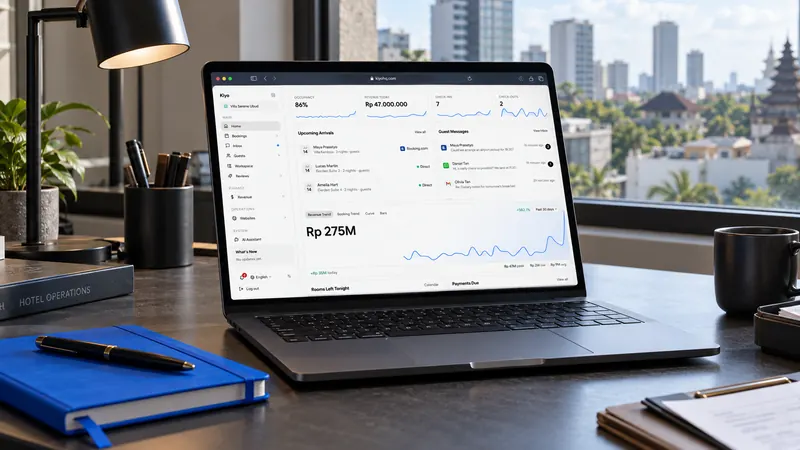
Kiyo is a property management system (PMS) and channel manager for independent hotels, villas, guest houses and homestays. It covers the five jobs above in one place.
One calendar. Every booking lands in one calendar. That includes OTA bookings, your own booking site, phone bookings and walk-ins. Reception can add a walk-in guest in a few taps, and mark the booking as already paid if the guest paid at the desk.
75+ OTAs. Kiyo connects to 75+ OTAs, including Booking.com, Airbnb, Agoda, Traveloka and tiket.com. When a guest books, the room locks on all channels within milliseconds.
Your own booking site on every plan. Guests can book you directly from a link you share on WhatsApp or Instagram. You can see what guests see in the guest booking demo (opens in new tab).
Bahasa Indonesia, all the way through. Your staff can switch the whole dashboard to Bahasa Indonesia. The Kiyo team also speaks Bahasa.
Room for a family team. The Starter plan includes 3 users, which suits many family homestays. On Pro and higher plans, guest messages from WhatsApp, Instagram, Booking.com, Airbnb and more come into one inbox.
Setup done with you. The Kiyo team sets up your rooms, prices and booking sites with you. After go-live you get your own WhatsApp group with the team, from 07:00 to 19:00 WITA, with 24/7 help if the system fails. Plans start from Rp40k per room per month (opens in new tab). Free setup, pay from go-live, 14-day money-back guarantee.
Not sure yet? Read is Kiyo right for your property (opens in new tab) for an honest look at who it fits.
Frequently asked questions
They are close. A homestay is usually a family home with rooms for guests, while a guest house may be a separate small building, but both need the same software jobs.
You can with one booking site and very few rooms. Once you sell on two or more sites, a spreadsheet cannot close rooms for you, so the risk of double bookings grows.
If you sell on two or more booking sites, yes, it usually saves time every day. With one site and mostly direct guests, a simple calendar may be enough at first.
In Kiyo, yes. The whole dashboard can switch to Bahasa Indonesia.
It depends on your number of rooms and booking sites. With Kiyo, the team does the setup with you, so you are not doing it alone.
 Add Kiyo to your preferred sources on Google